
Boundary County Probate Venue
Boundary County does not have a separate probate court page, a county court at law, or an independent probate clerk in the official sources reviewed. Probate matters are filed through the Boundary County District Court clerk in Bonners Ferry and proceed in Idaho's District Court and Magistrate Division structure. The Magistrate Division handles probate, guardianship, conservatorship, small claims, landlord-tenant, misdemeanor, infraction, family, and juvenile matters subject to the public-access limits that apply to each type.
The local court contact for probate case access is Boundary County District Court at 6452 Kootenai Street, Bonners Ferry, ID 83805, with mailing to P.O. Box 419, Bonners Ferry, ID 83805. The court phone is (208) 267-5504, fax is (208) 267-7814, and the court contact email shown in the research is gposton@boundarycountyid.org. The clerk channel is especially important because public iCourt status does not mean every probate document image is available online.
Boundary County Probate Jurisdiction
District Court and Magistrate Division
6452 Kootenai Street
Bonners Ferry, ID 83805
Mail: P.O. Box 419, Bonners Ferry, ID 83805
(208) 267-5504
Monday-Friday, 9:00 a.m.-5:00 p.m.
What Boundary Probate Covers
Probate covers more than a will. In Boundary County, probate files can include estate administration for a person who has died, petitions to admit a will, orders appointing a personal representative, inventories, creditor notices, accountings, and closing statements. A file may also involve small-estate procedures where Idaho law allows them, trust-related court matters if filed, guardianship of minors or incapacitated adults, and conservatorship for the management of another person's property or finances.
Idaho's main probate law source is Idaho Title 15, the Uniform Probate Code title. The title covers estates, wills, guardianships, conservatorships, and related court authority. That state law gives the legal framework, while the Boundary County clerk provides the local filing and copy route for records filed in Bonners Ferry.
Because Boundary County's court system is compact, probate users should avoid big-county assumptions. The same courthouse and clerk channel that handles other District Court and Magistrate Division records is the practical point of contact for estates, wills, guardianships, and conservatorships. The research did not find a separate probate counter, separate probate search site, or local probate fee page. That makes the case number, decedent name, filing year, and document title especially important when asking the clerk to locate an older or partly restricted file.
The official Idaho probate title is a relevant legal source for this topic. The Idaho Uniform Probate Code source anchors estate and guardianship terminology used in Boundary County probate records.
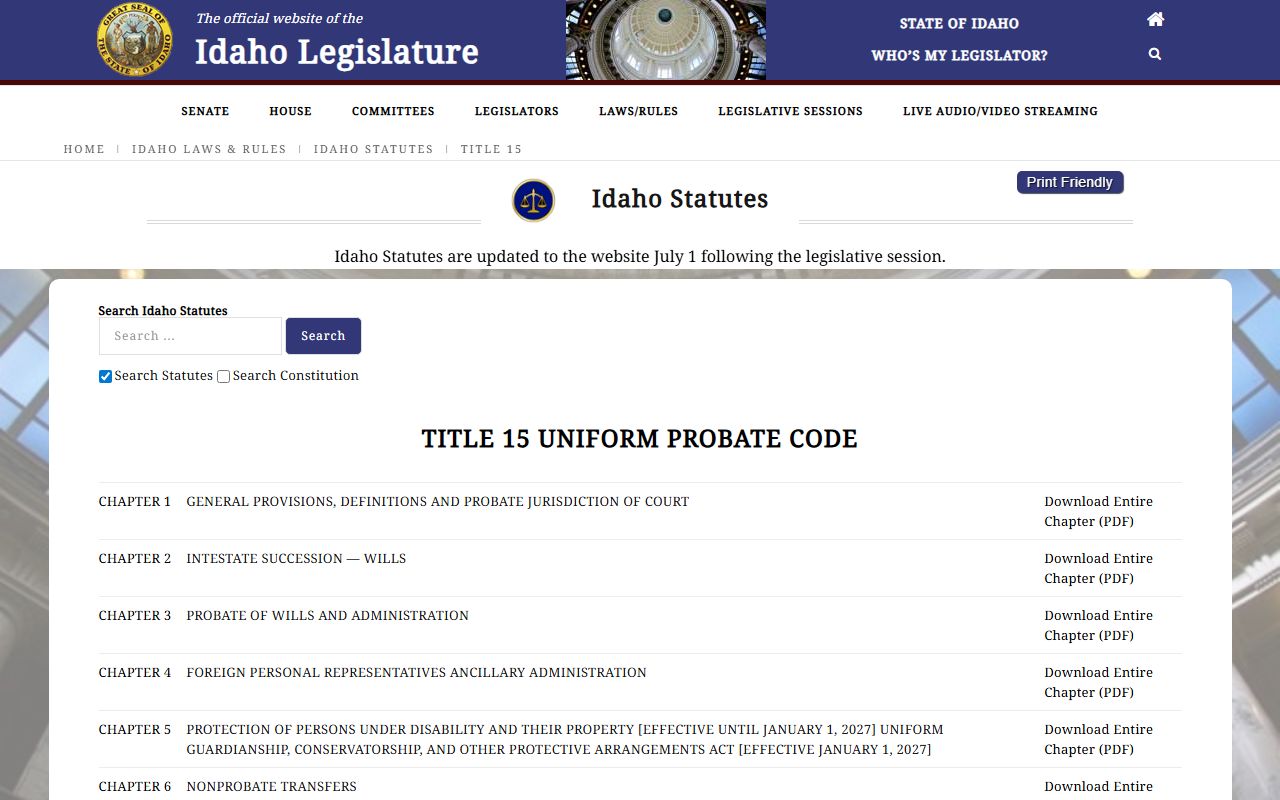
The state-law source helps explain why a local probate file may contain estate papers, guardianship papers, conservatorship papers, or a mix of related orders.
Boundary Probate Terms Defined
Probate records use terms that are short but dense. These definitions keep common Boundary County probate record entries clear when reading iCourt results, clerk copies, petitions, and court orders.
- Decedent
- The person who died and whose estate is the subject of the probate case.
- Testator
- A person who made a will before death.
- Personal representative
- The person appointed by the court to gather estate assets, handle notices, pay allowed debts, and distribute property.
- Intestate
- Dying without a valid will, so Idaho succession rules help decide who may inherit.
- Guardianship
- A court appointment to make care, placement, or personal decisions for a minor or incapacitated adult.
- Conservatorship
- A court appointment to manage another person's money, property, or financial affairs.
Search Boundary County Probate Cases
The online starting point is Idaho iCourt. Search by case number if it is known. For estate matters, try the decedent's name, estate name, petitioner, or personal representative. For guardianship or conservatorship, use extra care because protected adult, minor, medical, and financial details may be restricted or redacted.
- Start in iCourt Smart Search and choose Boundary County or the local court location if the portal offers a location filter.
- Search the decedent, estate, petitioner, personal representative, or case number. Variant names and initials can matter in older probate files.
- Use the public result to identify the case number, case type, filing date, parties, and visible docket events.
- If the document image is not public, use a courthouse kiosk or submit a records request to the Boundary County clerk.
- Call (208) 267-5504 when no result appears, because older files, restricted files, or alternate party names may not be obvious online.
Note: A missing iCourt result does not prove that no Boundary County probate file exists.
Boundary Probate Record Fields
A public probate record may show only a summary, while the clerk file contains the actual filings. The inventory below reflects the research file's probate field list and should be used to read visible case entries without assuming that all documents are downloadable.
| Field | What It Shows |
|---|---|
| Case number | The identifier needed for the most accurate clerk request or iCourt search. |
| Estate or decedent name | The person or estate tied to the probate proceeding. |
| Case type | Probate, estate, guardianship, conservatorship, or related category. |
| Petitioner or personal representative | The filer or court-appointed person handling estate duties. |
| Attorney | Attorney of record where one is listed publicly. |
| Docket events | Petition, will lodged or admitted, letters issued, creditor notice, inventory, accounting, order, or closing event. |
| Hearing dates | Scheduled or past probate hearings when visible. |
| Restrictions | Minor, medical capacity, financial-account, sealed report, and protected details may be hidden. |
Boundary Probate Fee Gaps
The research did not locate a Boundary County probate filing-fee schedule or a local copy-certification table for probate records. Do not use fees from another Idaho county as a substitute. Ask the Boundary County District Court clerk for the current amount before filing a probate petition, requesting letters, ordering plain copies, or asking for certified probate copies.
| Probate Item | Amount Found | Best Action |
|---|---|---|
| Estate petition filing | Not located in official Boundary sources | Call District Court clerk before filing. |
| Guardianship or conservatorship filing | Not located in official Boundary sources | Ask whether local or statewide court fees apply. |
| Letters or certified copies | Not located in official Boundary sources | Request a quote by case number and document type. |
| Plain copies from a case file | Not located in official Boundary sources | Use the clerk request channel or courthouse kiosk. |
| Search or retrieval fee | Not located in official Boundary sources | Ask the clerk before requesting older records. |
Boundary Probate Workflow
A common estate case starts when a petitioner files probate papers with the Boundary County District Court clerk. If a will exists, the filing may ask the court to admit the will and appoint a personal representative. If there is no will, Idaho intestacy rules guide priority and distribution. The court may then issue letters that let the representative gather assets, notify creditors, manage property, handle valid debts, and make distributions after required steps are complete.
Estate flow: Petition filed › will admitted or intestacy reviewed › personal representative appointed › letters issued › creditor notice and inventory › accounting or distribution › closing order or statement.
Guardianship and conservatorship matters need extra care. They can involve medical capacity, care plans, minor-child details, accountings, and financial reports. The public may be able to see that a case exists or that an order was entered, but detailed reports and protected personal information may be sealed, redacted, or available only to authorized people.
Restricted Boundary Probate Records
Idaho court records are governed by public-access rules, including Idaho Court Administrative Rule 32. iCourt warns that sealed cases and exempt case events will not appear in public search results. Probate files can be public in part and restricted in part, especially where minors, protected persons, medical proof, financial account numbers, or sensitive family details are involved.
For non-court county agency records, Idaho public-records law applies. For probate court files, the stronger practical path is the clerk and court procedure. Identify the case number, party name, document title, and whether a certified copy is needed before contacting the clerk. That lets staff distinguish between public docket status, document copies, and material that may need a judge's order or authorized-party status.
Probate records can also cross into other record systems. A death certificate is not a probate filing, and a recorded deed is not the same thing as an estate order. Likewise, a guardianship case may contain court orders but not every medical, school, care, or financial document connected to the protected person. When a Boundary County probate search does not produce the expected item, ask whether the item is a court filing, a recorded county document, a state vital record, or a private document that was never filed with the court.
Note: Guardianship and conservatorship files may be more restricted than ordinary estate files because they contain protected personal and financial details.